createConnection(options) returns an object whose one call is run(name, { data, args, dataId }).
| - pass unit connection: the call and its three answers RCON-API-001: createConnection returns an object whose one call is run (#2)
|
run always resolves to a result object and never rejects, whatever is thrown underneath, including a bare string.
| - pass unit connection: the call and its three answers RCON-API-002: run resolves and never rejects, whatever the engine throws (#2)
|
A call run cannot make sense of (no function name, data that is not an array of records, arguments that are not named) resolves to an error result whose message begins bio.viz:, and does not start R. | - pass unit connection: the call and its three answers RCON-API-003: a call run cannot make sense of resolves to an error, without starting R (#2)
|
A connection is refused when it is created if a browser-form setting is malformed: packages that are not a list of valid R package names, a source that is not text, both a source and a source URL, a location that is not text, or an engine without start and call. | - pass unit connection: the browser form starts R lazily and once RCON-API-004: a browser form with a malformed setting is refused when the connection is created (#2)
|
Both committed bundles export the connection and the formatter as r.createConnection and r.formatStatistic: BioViz.r on a page. | - pass unit bundle: the connection ships, webR does not RCON-API-005: BioViz.r.createConnection and BioViz.r.formatStatistic are exported by both committed bundles (#2)
|
When R answers, the result is { status: 'ok', value, form }: the value R returned, and which form answered, precomputed, browser or server. | - pass unit connection: the call and its three answers RCON-RES-001: ok carries the value R returned and the form that answered (#2)
|
With no form configured, the result is { status: 'unavailable', reason: 'no-r-attached', message }, and nothing is requested. | - pass browser RCON-RES-002: with no form configured the page answers unavailable, and requests nothing (#2)
- pass unit connection: the call and its three answers RCON-RES-002: with no form configured, run answers unavailable with a reason (#2)
|
When the R function fails, the result is { status: 'error', message } with R's message. | - pass unit connection: the call and its three answers RCON-RES-003: error carries R's message when the R function fails (#2)
|
With stored results, a call that has one is answered without starting R and without a network request. | - pass browser RCON-PRE-001: with stored results the page answers without making a network request (#2)
- pass unit connection: the precomputed form RCON-PRE-001: a stored result is answered with nothing loaded and no network request (#2)
|
A stored result is found by its function name, its arguments and its data identity together; the order the arguments are written in does not matter. | - pass unit connection: the precomputed form RCON-PRE-002: a stored result is keyed by function name, arguments and data identity; argument order does not matter (#2)
|
A call with no exact stored result is answered unavailable with reason not-precomputed and no value: another function, other arguments, other data, no data identity given, or a row count that differs from the one recorded. | - pass unit connection: the precomputed form RCON-PRE-003: a call with no stored result answers unavailable, never another result (#2)
|
Stored results that are malformed, or that hold two results under one key, are refused when the connection is created. | - pass unit connection: the precomputed form RCON-PRE-004: stored results that are malformed or ambiguous are refused when the connection is created (#2)
|
With stored results and the browser form configured, a call with no stored result is answered by R in the browser. | - pass unit connection: the precomputed form RCON-PRE-005: with stored results and the browser form, a call with no stored result goes to R in the browser (#2)
|
Changing a value a call returned does not change the stored result. | - pass unit connection: the precomputed form RCON-PRE-006: changing a returned value does not change the stored result (#2)
|
A stored answer's "Inf", "-Inf" and "NaN", where R returned a number, are read as Infinity, -Infinity and NaN, as R in the browser hands them over; text spelled so in a name, a group, a category or a note stays text, and the stored result is not changed. | - pass unit connection: R’s non-finite numbers in a stored answer RCON-PRE-007: a stored answer’s "Inf", "-Inf" and "NaN" where R returned a number are read as Infinity, -Infinity and NaN, as R in the browser hands them over; text elsewhere spelled so is left as text (#78)
|
With a server form, a call is answered through the engine the page supplied, as { status: 'ok', value, form: 'server' }; creating the connection starts nothing, the first run that needs R starts the engine once, with nothing of webR's, and later runs reuse it. | - pass unit connection: the server form RCON-SRV-001: with a server form, a call is answered through its engine as form server; creating the connection starts nothing, the first run starts the engine once with nothing of webR’s, and later runs reuse it (#122)
|
A server form given computedBy, which R answers there, hands that record with every answer from the server; a record that is not one is refused when the connection is created. | - pass unit connection: the server form RCON-SRV-002: a server form given computedBy, which R answers there, hands that record with every answer from the server; one that is not a record is refused when the connection is created (#122)
|
With stored results and a server form, a call with a stored result is answered from it without reaching the server, with the stored results' own record, and a call with none goes to the server. | - pass unit connection: the server form RCON-SRV-003: with stored results and a server form, a stored result answers without the server, with its own record, and a call with none goes to the server (#122)
|
A server's answer is read as a stored one is: "Inf", "-Inf" and "NaN", where R returned a number, are Infinity, -Infinity and NaN, and text spelled so elsewhere stays text. | - pass unit connection: the server form RCON-SRV-004: a server’s answer is read as a stored one is: "Inf", "-Inf" and "NaN" where R returned a number are Infinity, -Infinity and NaN, and text elsewhere spelled so is left as text (#122)
|
A server that cannot be reached answers unavailable with reason load-failed and the cause, in words about the server, and the next run tries again; an error R reports there is { status: 'error', message } with R's message. | - pass unit connection: the server form RCON-SRV-005: a server that cannot be reached answers unavailable with reason load-failed and the cause, in words about the server, and the next run tries again; an error R reports there is an error with R’s message (#122)
|
A server form is refused when the connection is created if it is not an object of settings, if its engine is missing or lacks start or call, or if a browser form is given with it. | - pass unit connection: the server form RCON-SRV-006: a server form is refused when the connection is created if it is not an object of settings, if its engine is missing or lacks start or call, or if a browser form is given with it (#122)
|
An engine that loses its server after reaching it rejects with unreachable true: the answer is unavailable with reason load-failed, not an error of R's, and the next run starts the engine again; the browser form has no such answer. | - pass unit connection: the server form RCON-SRV-007: an engine that loses its server after reaching it rejects with unreachable true: the answer is unavailable with reason load-failed, not an error of R’s, and the next run starts the engine again (#122)
|
A rejection marked unreachable forgets only the start its own call waited on. With two calls in flight and one rejected, the other's rejection, arriving after a later start has begun, begins no second start beside the one still running, and arriving after a later start has succeeded, does not discard it: the engine's start() is never running twice at once. | - pass unit connection: the server form RCON-SRV-008: a rejection marked unreachable forgets only the start its call waited on: with two calls in flight and one rejected, the other’s late rejection neither begins a second start beside one still running nor discards a start that succeeded since (#127)
|
A server's answer is copied before it is read, as a stored one is, so the object the engine resolved to is left as it was given, and a frozen one is read. An answer that cannot be copied or read is unavailable with reason answer-unreadable and the cause, not an error of R's, and the engine is not started again. | - pass unit connection: the server form RCON-SRV-009: a server’s answer is copied before it is read, so the engine’s own object is left as it was given, frozen or not; an answer the page cannot read is unavailable with reason answer-unreadable and the cause, not an error of R’s, and the engine is not started again (#127)
|
An engine that rejects with no message, from its start or from a call marked unreachable, is answered with one sentence, Statistics are unavailable: R on the server could not be reached., with no cause in brackets. | - pass unit connection: the server form RCON-SRV-010: an engine that rejects with no message, from its start or from a call marked unreachable, is answered with one sentence, that R on the server could not be reached, and no cause in brackets (#127)
|
A server form's computedBy may hold computed_at beside r_version and gsm_bio_version, each text; white space around each is trimmed in the record handed with an answer, and a member that is not text is refused in a sentence that names all three. | - pass unit connection: the server form RCON-SRV-011: a server form’s computedBy may hold computed_at beside r_version and gsm_bio_version, each text; white space around each is trimmed in the record handed with an answer, and a member that is not text is refused in a sentence that names all three (#127)
|
Creating a connection starts nothing; the first run that needs R starts the engine, with the location, packages and source the connection was given. | - pass unit connection: the browser form starts R lazily and once RCON-LAZY-001: creating a connection starts nothing; the first run starts the engine with its configuration (#2)
|
Two simultaneous first calls cause one start, and later calls reuse it. | - pass unit connection: the browser form starts R lazily and once RCON-LAZY-002: two simultaneous first calls cause one start, and later calls reuse it (#2)
|
A start that fails answers unavailable with reason load-failed and the cause, for every call waiting on it, and the next run tries again. | - pass browser RCON-LAZY-003: when webR cannot be fetched the page answers unavailable with the cause (#2)
- pass unit connection: the browser form starts R lazily and once RCON-LAZY-003: a failed start answers unavailable for every waiting call, and the next run tries again (#2)
|
In the browser form nothing is requested until the first run, and two simultaneous first runs load webR once. | - pass browser RCON-LAZY-004: the browser form requests nothing until the first run, and two simultaneous first runs load webR once (#2)
- pass unit webR engine: what is loaded, and from where RCON-LAZY-004: nothing is imported until the first run, and two simultaneous first runs import once (#2)
|
Two connections share no state: each has its own stored results and starts its own engine. | - pass unit connection: the browser form starts R lazily and once RCON-ISO-001: two connections share nothing: each starts its own engine (#2)
|
webR is pinned to version 0.6.0 and loaded from its public CDN unless another location is given; a location relative to the page is resolved against the page. | - pass browser RCON-WEBR-001: by default the page asks the public CDN for webR 0.6.0, and only on the first run (#2)
- pass unit webR engine: what is loaded, and from where RCON-WEBR-001: webR is pinned to 0.6.0 and loaded from the public CDN unless another location is given (#2)
|
webR is started on the PostMessage channel on every host. | - pass unit webR engine: what is loaded, and from where RCON-WEBR-002: webR is started on the PostMessage channel (#2)
|
The R packages the connection was told to are installed and attached, and the R source it was given is evaluated once. | - pass unit webR engine: what is loaded, and from where RCON-WEBR-003: the packages it was told to are installed and attached, and the R source is evaluated once (#2)
|
An R source given by URL is fetched on the first run, not before, and once. | - pass unit webR engine: what is loaded, and from where RCON-WEBR-004: an R source given by URL is fetched on the first run, not before (#2)
|
A start that fails part-way closes the R session it opened and reports the cause. | - pass unit webR engine: what is loaded, and from where RCON-WEBR-005: a start that fails closes what it opened and reports why (#2)
|
The array of records goes to R as one column per variable, with the function name and the arguments, each as an R named list. | - pass unit webR engine: one call RCON-CALL-001: the records go to R as columns, with the function name and the arguments (#2)
|
Every column has a value for every row; a value that is absent or not a number goes to R as missing. | - pass unit webR engine: one call RCON-CALL-002: recordsToColumns gives every column every row, with missing values as null (#2)
|
The list R returns comes back as plain JavaScript objects, arrays, numbers, text and booleans. | - pass unit webR engine: one call RCON-CALL-003: the list R returns becomes plain JavaScript (#2)
|
Each kind of R value other than a data frame has one JavaScript shape: a named list or named vector is an object, an unnamed list is an array, an unnamed vector is a single value when its length is one and an array otherwise, and NULL or NA is null. A value with no plain form is an error. | - pass unit webR engine: one call RCON-CALL-004: toPlain maps each kind of R value to one JavaScript shape (#2)
|
An R error is reported with R's own message and nothing added, and the R objects made for a call are released whether it succeeds or fails. | - pass unit webR engine: one call RCON-CALL-005: an R error is reported with R's message, and the R objects of the call are released (#2)
|
Nested arguments go to R as nested lists, and a call with no data or no arguments sends none. | - pass unit webR engine: one call RCON-CALL-006: nested arguments go to R as nested lists, and a call with no data or arguments sends neither (#2)
|
The R code that passes a table in and a result out uses base R only, and computes no statistic. | - pass unit webR engine: one call RCON-CALL-007: the R that passes a table in and a result out uses base R only (#2)
|
A data frame R returns, at any depth, comes back as an array of row objects, one per row, with every column in every row and NA as null: an empty array for no rows and an array of one object for one row, the same shape data has going in. | - pass unit webR engine: one call RCON-CALL-008: a data frame R returns becomes an array of row objects, whatever its size and depth (#2)
|
The build bundles only files under src/ and does not resolve the webR import. | - pass unit bundle: the connection ships, webR does not RCON-BUILD-001: the build bundles only files under src/ and does not resolve the webR import (#2)
|
The committed bundles keep the import of webR as a run-time import of a URL and contain none of webR: every file a bundle names as one it was made from is a file under src/, and the bundles hold no known marker of webR's code. | - pass unit bundle: the connection ships, webR does not RCON-BUILD-002: the committed bundles keep the dynamic import and carry none of webR (#2)
|
The r module imports nothing from outside src/r/, so the connection can be handed to a chart in another library. | - pass unit bundle: the connection ships, webR does not RCON-BUILD-003: the r module imports nothing from outside src/r (#2)
|
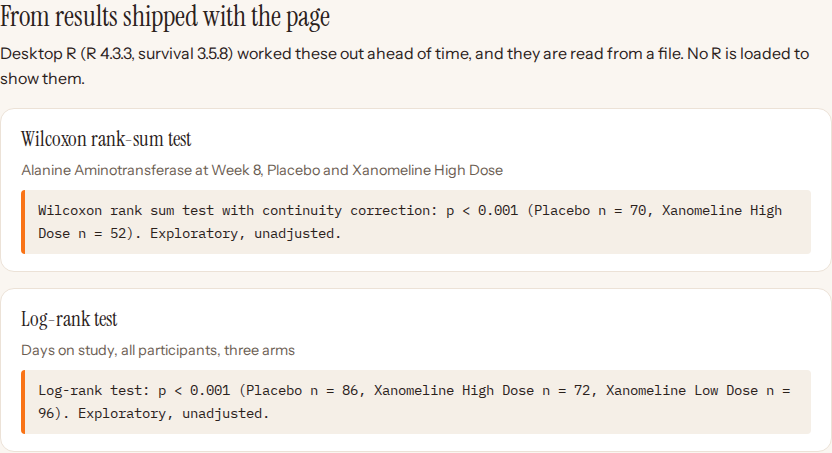
On the R check page two numbers count as the same answer when they differ by no more than 1 part in 10^8 of the larger; zero equals only zero, and something that is not a number equals nothing. | - pass unit R check page: comparing two answers from R RCON-CHECK-001: two numbers agree when they differ by no more than 1 part in 10^8, and not beyond (#3)
|
Every member of an answer is compared with the expected one: numbers by the tolerance; text, counts, warnings and the shape of the answer exactly. A member missing or added fails. | - pass unit R check page: comparing two answers from R RCON-CHECK-002: every member is compared: numbers by the tolerance, text and structure exactly (#3)
|
A number is shown in full, as the shortest text that reads back as exactly that number, so a difference in the last digit is visible. | - pass unit R check page: comparing two answers from R RCON-CHECK-003: a number is shown in full, so a difference in the last digit is visible (#3)
|
The page's tables are read from CSV with their numeric columns as numbers and blanks as missing. | - pass unit R check page: comparing two answers from R RCON-CHECK-004: a table is read from CSV with its numeric columns as numbers and blanks as missing (#3)
|
The committed expected results name the script, the R version and the survival version that made them. | - pass unit R check page: the committed expected results RCON-CHECK-005: the expected results name the script, the R version and the survival version that made them (#3)
|
Each expected result is a stored result on its committed table: given to the precomputed form with that table, it is answered. | - pass unit R check page: the committed expected results RCON-CHECK-006: each expected result is a stored result on its committed table, which the precomputed form answers (#3)
|
The R check page has a button that starts R and does not start it otherwise; it states the tolerance and the R and survival versions that made the desktop answers. | - pass unit R check page RCON-PAGE-001: the page has a button that starts R, the stated tolerance and the versions desktop R used (#3)
|
The page shows the recorded megabytes, requests, requests answered from the network and seconds for three states named separately, cold, reload and warm, with the browser, machine, date and method of the measurement. | - pass unit R check page RCON-PAGE-002: the recorded megabytes, requests and seconds are shown for cold, reload and warm, with how they were measured (#3)
|
With no measurement recorded the page says so and prints no number in its place. | - pass unit R check page RCON-PAGE-003: with no recorded measurement the page says so and prints no number in its place (#3)
|
On the R check page, with no R attached, the call answers that statistics are unavailable. | - pass browser RCON-LIVE-001: with no R attached the page answers that statistics are unavailable (#3)
|
On the R check page the precomputed form gives the desktop-R answers for both tests with no R loaded and no request to R's hosts. | - pass browser RCON-LIVE-002: the precomputed form gives the desktop-R answers with no R loaded and no request to R's hosts (#3)
|
R started in the browser gives the Wilcoxon rank-sum result desktop R gives, within the stated tolerance. | - pass browser RCON-LIVE-003: R in the browser gives the rank-sum result desktop R gives, within the stated tolerance (#3)
|
The survival package installs and loads in the browser, and the log-rank result is the one desktop R gives, within the stated tolerance. | - pass browser RCON-LIVE-004: the survival package installs and loads, and the log-rank result is the one desktop R gives (#3)
|
Cold, a first visit with nothing cached: megabytes over the network, requests and seconds to the first result are measured, and webR is loaded once from the pinned version on its public CDN. | - pass browser RCON-LIVE-005: cold, a first visit with nothing cached: megabytes, requests and seconds to the first result (#3)
|
Reload, the page loaded again with the files in the browser's cache: R starts again, gives the same answers, and less comes over the network than on the first visit; megabytes, requests and seconds are measured. | - pass browser RCON-LIVE-006: reload, the page loaded again with the files cached: R starts again and gives the same answers (#3)
|
Warm, R already running in the page: a repeated call makes no request and takes less time than the first result; its seconds are measured. | - pass browser RCON-LIVE-007: warm, R already running: a repeated call makes no request (#3)
|
The R check page holds at a 390-pixel-wide viewport with no horizontal scroll, with its results shown. | - pass browser RCON-LIVE-008: the R check page holds at a 390px-wide viewport with its results shown (#3)
|
The three measurements are printed in the run's log, attached to the test and written to a file, with the browser, the machine and how sizes were counted. | - pass browser RCON-LIVE-009: the three measurements are recorded where a reader of the run can find them (#3)
|
An ordinary p-value is printed to three decimals, after the method's name and before the counts used. | - pass browser PVAL-FMT-001: a page formats a result from the connection with its method and counts (#2)
- pass unit formatStatistic: the formatted text PVAL-FMT-001: an ordinary p-value is shown to three decimals with its method and counts (#2)
|
A p-value below 0.001 is printed as p < 0.001, never as zero or in exponent form. | - pass unit formatStatistic: the formatted text PVAL-FMT-002: a small p-value is shown as p < 0.001, never as zero (#2)
|
A p-value that would round to 1.000 is printed as p > 0.999. | - pass unit formatStatistic: the formatted text PVAL-FMT-003: a p-value that would print as 1.000 is shown as p > 0.999 (#2)
|
Counts are printed for each group by name, or as one total. | - pass unit formatStatistic: the formatted text PVAL-FMT-004: counts are printed for each group, or as one total (#2)
|
A p-value whose result names no method is refused: the text says so and prints no number. | - pass unit formatStatistic: the rules PVAL-RULE-001: a p-value with no method named is refused, and no number is printed (#2)
|
A p-value whose result gives no counts is refused: the text says so and prints no number. | - pass unit formatStatistic: the rules PVAL-RULE-002: a p-value with no counts is refused, and no number is printed (#2)
|
A result is labelled exploratory, and unadjusted unless the result names an adjustment, which is then named. | - pass unit formatStatistic: the rules PVAL-RULE-003: a result is labelled exploratory and unadjusted unless an adjustment is named (#2)
|
The text never contains a star or the word significant, however small the p-value. | - pass unit formatStatistic: the rules PVAL-RULE-004: no stars and never the word significant, however small the p-value (#2)
|
Where R gave a reason in place of a number, such as a group too small to test, the reason is printed and no number is. | - pass unit formatStatistic: the rules PVAL-RULE-005: a group too small to test shows the reason in place of a number (#2)
|
A p-value that is not a number from 0 to 1 is refused, not repaired. | - pass unit formatStatistic: the rules PVAL-RULE-006: a p-value that is not a number between 0 and 1 is refused, not repaired (#2)
|
The formatter computes nothing: the same result always gives the same text, and the result is left unchanged. | - pass unit formatStatistic: the rules PVAL-RULE-007: the same result always formats to the same text, and the result is not changed (#2)
|
A reason that already says the result was not computed is printed as it is, with the counts after it, so that "not computed" is said once. | - pass unit formatStatistic: what R declined, and what R could not do PVAL-RULE-008: a reason that already says the result was not computed is printed as it is, and "not computed" is said once (#16)
|
A result R marked as an error is printed as R's message, said to be an error, with the counts where R knew them and no number. | - pass unit formatStatistic: what R declined, and what R could not do PVAL-RULE-009: a result R marked as an error is printed as R’s message, said to be an error, with no number (#16)
|
An adjustment R names by its p.adjust method is printed by its usual name, holm as Holm and BH as Benjamini-Hochberg; any other name is printed as given. | - pass unit formatStatistic: what R declined, and what R could not do PVAL-RULE-010: an adjustment R names by its p.adjust method is printed by its usual name, and any other name as given (#16)
|
A p-value R returns a rounding above 1, as fisher.test() does (1.0000000000000002) for a table no other is less likely than, is read as 1 and printed p > 0.999, in a result, a screen's row and a level's row; a value more than 0.000000001 above 1, or any below 0, is still refused. | - pass unit formatStatistic: the rules PVAL-RULE-011: a p-value that exceeds 1 only by the rounding of a sum, as R’s fisher.test() returns when no table is less likely than the one observed, is read as 1 and printed p > 0.999; anything further above 1 is still refused (#104)
|
An estimate is printed with its name, what it is an estimate of, and its interval with the level R gave, each number to four significant figures; an estimate with no interval is printed without one. | - pass unit formatEstimate: an estimate and its interval PVAL-EST-001: an estimate is printed with its name, what it is an estimate of, and its interval with the level R gave, to four significant figures (#16)
|
An estimate with no name or no number (not-a-number among them), or with an interval that has a part missing, is refused, and no number is printed in its place. | - pass unit formatEstimate: an estimate and its interval PVAL-EST-002: an estimate with no name or no number, or with half an interval, is refused and nothing is printed in its place (#16)
|
An infinite estimate or bound R gave, as Fisher's odds ratio of a table with an empty cell, is printed in words (infinite, infinity, minus infinity) with the finite bound as it is; not-a-number is still refused. | - pass unit formatEstimate: an estimate and its interval PVAL-EST-003: an infinite estimate or bound R gave is printed as infinite, with the finite bound as it is; not-a-number is still refused (#78)
|
A median survival time is printed with what it is a median of and its interval with the level R gave, to four significant figures; a median or a bound R did not reach reads not reached. | - pass unit formatMedian: a median survival time PVAL-MED-001: a median is printed with what it is a median of and its interval, to four significant figures, and a median or bound R did not reach reads not reached (#61)
|
A median with no name, a part that is neither a number nor missing, or no level for its interval, is refused, and no number is printed in its place. | - pass unit formatMedian: a median survival time PVAL-MED-002: a median with no name, a value that is neither a number nor missing, or no level for its interval, is refused, and no number is printed in its place (#61)
|
One comparison of two groups from a result's rows is formatted by the rules a whole result is held to: its p-value, the adjusted one, comes with its method, the two groups' counts and its label, and is handed over in parts for a table only with them. | - pass unit formatComparison: one pair of groups from a result’s rows PVAL-ROW-001: a pair’s p-value comes with its method, the two groups’ counts and its adjustment label, by the rules a whole result is held to (#16)
|
A comparison with no method, no counts or no two groups is refused, and one R could not compute shows R's words and no number. | - pass unit formatComparison: one pair of groups from a result’s rows PVAL-ROW-002: a pair with no method, no counts or no groups is refused, and one R could not compute shows R’s words and no number (#16)
|
One group's result from a result's rows is formatted by the rules a whole result is held to: its estimate comes with its interval at the level R gave, or with none where R gave none, and its p-value with its method, the group's count and its label; all are handed over in parts for a table only together. | - pass unit formatGroup: one group’s result from a result’s rows PVAL-GRP-001: a group’s estimate comes with its interval at the level R gave, and its p-value with its method, the group’s count and its label, by the rules a whole result is held to (#26)
|
A group's result with no group name, no method, no count, no estimate or half an interval is refused, and one R could not compute shows R's words and no number. | - pass unit formatGroup: one group’s result from a result’s rows PVAL-GRP-002: a group with no name, no method, no count, no estimate or half an interval is refused, and one R could not compute shows R’s words and no number (#26)
|
One pair's result from a correlation matrix's rows is formatted without a p-value: its estimate to four significant figures, its interval at the level R gave, or none where R gave none, and the number of complete pairs; all are handed over in parts for a cell and a table. A p-value on the row is neither read nor printed. | - pass unit formatPair: one pair’s result from a correlation matrix’s rows PVAL-PAIR-001: a pair’s estimate comes with its interval at the level R gave and its count, in parts for a cell and a table, and with no p-value even where a row carries one (#27)
|
A pair's result that does not name its two variables, or has no count, no estimate or half an interval, is refused, and one R could not compute shows R's words with its count and no number. | - pass unit formatPair: one pair’s result from a correlation matrix’s rows PVAL-PAIR-002: a pair with no two variables, no count, no estimate or half an interval is refused, and one R could not compute shows R’s words with its count and no number (#27)
|
One row of a biomarker screen is formatted by the rules a whole result is held to: its estimate with its interval at the level R gave, or none where R gave none, its unadjusted p-value with its method and counts, each group's for a difference, and its adjusted p-value with the adjustment by name and how many rows it was adjusted across; all are handed over in parts for a table. | - pass unit formatScreenRow: one row of a biomarker screen PVAL-SCREEN-001: a row’s estimate comes with its interval, its unadjusted p-value with its method and each group’s count, and its adjusted p-value with the adjustment by name and how many rows it covered, in parts for a table (#36)
|
A row with no biomarker, no method, no counts, no estimate, half an interval, no adjustment or no number of rows adjusted across is refused, and one R could not compute shows R's words with its counts and no number. | - pass unit formatScreenRow: one row of a biomarker screen PVAL-SCREEN-002: a row with something missing is refused, and one R could not compute shows R’s words with its counts and no number (#36)
|
One level's result from the rows of a request by level, a visit's among them, is formatted in parts for a table: its p-value as R returned it, adjusted where R adjusted, with its method, each group's count and the level's label; an adjusted one names the adjustment and how many levels it covered, beside the unadjusted one. | - pass unit formatLevel: one level of a by-level answer PVAL-LEVEL-001: a level’s p-value comes with its method, each group’s count and its label, in parts for a table; an adjusted one names the adjustment and how many levels it covered, beside the unadjusted one (#85)
|
A level R could not compute shows R's words with each group's count and no number; a row with no level, fewer than two groups named, no method, no counts, no unadjusted p-value or no number of levels adjusted across is refused. | - pass unit formatLevel: one level of a by-level answer PVAL-LEVEL-002: a level R could not compute shows R’s words with each group’s count and no number; a row with no level, fewer than two groups named, no method, no counts, no unadjusted p-value or no number of levels adjusted across is refused (#85)
|
The README's example prints what formatStatistic prints for desktop R's own Wilcoxon answer, R's method name as R wrote it. | - pass unit the formatter in the README PVAL-FMT-005: the README’s example prints what formatStatistic prints for desktop R’s own Wilcoxon answer, R’s method name as R wrote it (#49)
|