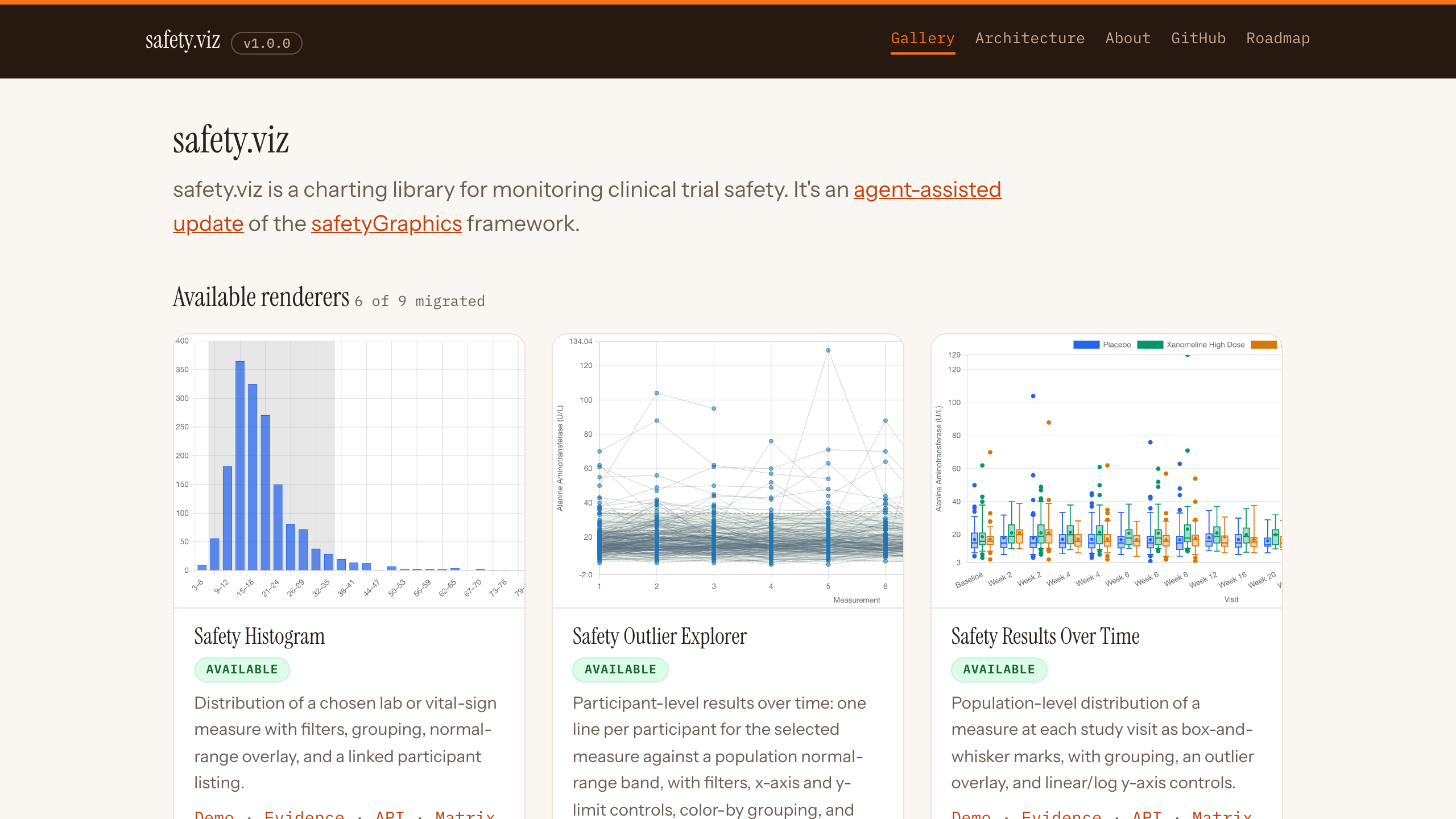
At 9:17 on the morning of July 11th, safety.viz
— the Chart.js library that’s replacing the old
{safetyGraphics} renderers — had one working chart. By
11:40, a release-candidate PR was open with six: histogram, four new lab
renderers, and a stretch-goal adverse-event timeline that needed a whole
new data domain. 247 unit tests and 92 browser tests, all green. I sent
about six messages the entire time.
This series has promised an honest accounting of what agentic
development actually costs, so this post is that: what ran, what broke,
what I actually did, and the bill.
The Shape of the Morning
The plan was something I’ve started calling an “ultracode” session:
instead of one agent grinding through a task list, an orchestrator runs
multiple workstreams in parallel and I supervise from a distance.
Two workstreams launched together:
- A website agent — a single agent doing a full
overhaul of the docs site: gallery, evidence pages, API reference.
- A scripted workflow — and this is the interesting
part — a piece of deterministic orchestration code, not a model
improvising a plan. The script defined the stages: fix two gating
defects, then fan out five renderer builders in parallel, then
integrate. Every step journaled to disk with a run ID.
That distinction matters more than I expected. When things went wrong
(they did — see below), the scripted workflow resumed from its journal
like nothing happened. The improvising agent did not.
Gates Before Fan-Out
The sequencing insight of the day: two fixes ran before the
fan-out, because the five new renderers were all going to clone the
histogram module’s pattern. Ship a defect in the template and you ship
it five times.
Gate one was a histogram binning bug (#19) with a
genuinely fun diagnosis. The new Chart.js histogram didn’t match the
2017-era original. To find out why, the agent cloned the original
renderer, actually executed its d3-v3 source, and pinned it
down: Webcharts used a quantile scale for binning, and a quantile scale
over a two-point domain degenerates to uniform bins. Nine-year-old
behavior, reproduced from primary sources rather than guessed at. The
fix went up as its own small PR and was green in about an hour.
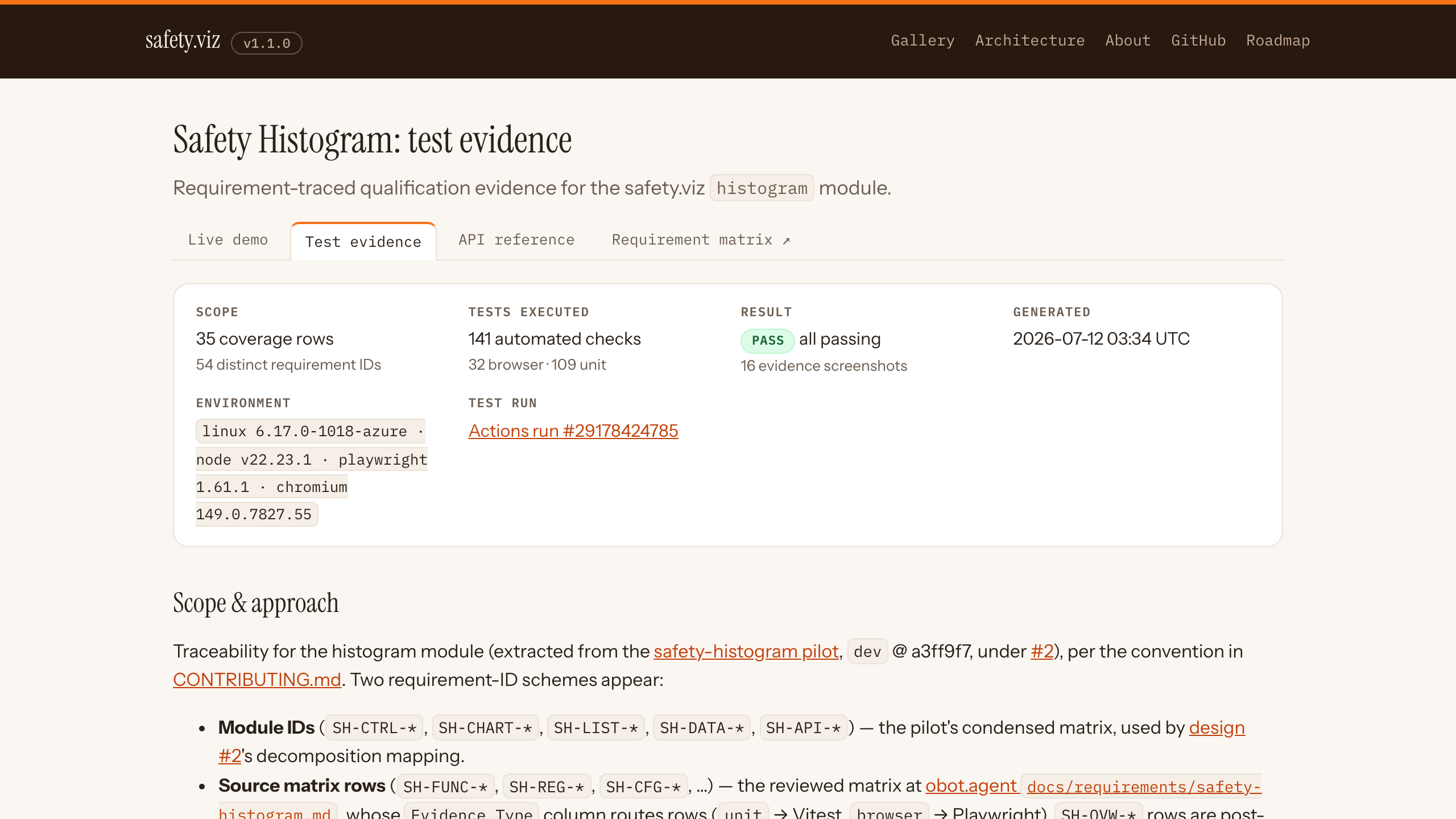
Gate two generalized the evidence pipeline — the
machinery that produces the screenshots and requirement-coverage reports
we treat as validation evidence — from “works for one module” to “works
for N modules,” with CI stamping provenance on every evidence set.
Then the fan-out: five renderer builders in parallel git worktrees on
parameterized ports, each doing red-green TDD against requirement
matrices harvested from the original {safetyGraphics}
charts. All five shipped, including the adverse-event-timelines stretch
goal, which needed a newly vendored ADAE dataset. Between them: 139 new
unit tests, 68 new browser tests, and — importantly — requirement rows
that didn’t make the cut were descoped honestly and documented
per module, not quietly dropped.
Picking Models Like Picking
Staff
Mid-session I sent one piece of guidance: “pick the best model, don’t
have to use fable for everything.” The orchestrator split the work
accordingly — Claude Fable 5 for the judgment-heavy jobs (the two gates,
the stretch renderer, integration, website design, conflict
reconciliation) and Claude Opus 4.8 for the four lab-renderer builders,
which were following an established template.
The mechanics of the reallocation were the striking part. The
workflow script is a persisted artifact, so the orchestrator edited the
model assignments in the script and resumed from the run ID. Completed
steps replayed from cache; only new work ran on the new models. Editing
a config file mid-flight and resuming is the most boring possible
description of that, which is exactly the point — boring is what you
want from orchestration.
What Broke
Honesty section. Four things went wrong, and they’re the most
instructive part of the morning.
The session limit killed everything, 13 minutes in.
I run this on a Claude subscription plan with rolling session limits,
and at 9:30 the ceiling landed on both workstreams at once. The scripted
workflow shrugged — journal on disk, resumed cleanly when I said
“continue.” The website agent was another story. Its ~1,060 lines of
uncommitted work on disk survived fine, and a successor agent triaged
all of it and kept everything. But its design-review catalog — the
analysis of what needed fixing across the site — lived only in the dead
agent’s transcript and had to be redone from scratch. Lesson, now
written in the project memory: transcript-only deliverables die
with the session. Commit working notes.
The permission classifier refused to let the orchestrator
merge. Even after I’d approved a PR, the agent’s attempt to
merge it was blocked. Annoying in the moment, correct on reflection:
this workspace has a hard “never merge without Jeremy’s explicit
approval” rule, and the classifier can’t see into a conversation to
verify approval happened. So the boundary holds mechanically and the
human clicks merge. I’ll take a guardrail that’s occasionally
overcautious over one that’s occasionally absent.
Large binary pushes died on HTTP/2 with a git error
message that pointed everywhere except the actual problem. Not an agent
failure — just ordinary infrastructure friction that agents hit exactly
the way we do, and then have to debug through the same misleading error
text.
All four Opus builders independently made the identical
one-line framework fix. Same defect, same file, same fix, four
times, in four isolated worktrees. Convergent evolution is a nice
validation signal — four independent agents agreed on the diagnosis —
but integration had to notice and dedupe it. Parallel agents don’t just
divide work; they occasionally quadruplicate it.
Review Gates as Pull
Requests
My other mid-session redirect: no giant release-candidate dump.
Instead, three staged PRs, each with a live GitHub Pages preview I could
open in a browser:
- #23 — the binning fix. Small, reviewable, green in
about an hour.
- #22 — the docs-site overhaul. Approved the same
morning; my entire review comment was “website looks great!”
- #28 — the RC itself: five renderers plus framework
changes, superseding the other two.
This is the “autonomy with review gates” thesis from the last post,
made concrete. The agents ran autonomously between the gates;
the gates were PRs with rendered previews, sized so a human could
actually review them.
Integration deserves a line of its own. Five branches merged, with
every shared-file conflict reconciled rather than force-resolved —
including one where two agents had independently re-vendored the same
CSV and the reconciler verified the files value-identical, row for row,
before picking one. Final battery: 247 unit tests, 92 Playwright tests,
6 evidence sets with CI provenance, and an authorship audit showing all
46 commits correctly attributed to the obotclaw[bot] app
identity.
What the Human Actually Did
My complete contribution, reconstructed from the transcript: the
kickoff message, the model-allocation guidance, two “continue”s after
the outage, the staged-PR redirect, and the website approval. Six short
messages, maybe ten minutes of typing, plus the PR reviews themselves.
The reviews were the real work, and they were the right work —
that’s where the judgment belongs.
The Bill
The numbers, as promised.
Wall clock: kickoff 09:17 ET, RC PR open ~11:40 ET.
About 2 hours 20 minutes, including the 15-minute session-limit
outage.
Agents: 1 orchestrator plus 12 subagent spawns — 10
completed, 1 killed mid-work by the usage limit, 1 that died instantly
on the same limit. The scripted workflow alone ran 8 agents through 918
tool calls over 98 minutes, reporting 1,973,684 subagent tokens. The
successor website agent: 190,341 tokens across 105 tool calls in 32
minutes. The reconciliation agent: 72,178 tokens, 33 tool calls, six and
a half minutes. The aborted first workflow run burned 136,069 tokens
before dying. Total reported subagent tokens: about 2.37
million (the orchestrator’s own overhead isn’t in these
counters).
Cost, two ways:
Plan-adjusted: I run this on a subscription plan, so the
day’s marginal dollar cost was $0. The real cost was
hitting the session ceiling 13 minutes in and spending 15 minutes
waiting and recovering. On a subscription, the scarce resource isn’t
dollars — it’s the rolling limit, and multi-agent fan-out eats it
fast.
Raw API-equivalent (rough estimate): at current list prices
— Fable 5 at $50 per million output tokens, Opus 4.8 at $25 — the ~2.37M
reported tokens would be somewhere around $60–$120 in output
tokens depending on how the Fable/Opus split shakes out (my
best guess with the day’s allocation: roughly $90). Big caveat: these
counters are output-weighted and don’t capture input or cache-read
traffic, which on agentic work is substantial. A defensible
order-of-magnitude for the full morning is low hundreds of
dollars — call it $150–$400 — and I wouldn’t quote it tighter
than that.
For a morning that produced a six-renderer release candidate with 339
passing tests and full evidence trails, either framing seems like a
bargain. For a morning that produced the wrong six renderers,
it would be an expensive way to generate review work. The gates are what
keep it the first thing.
What This Means for October
The keynote thesis this diary keeps circling: the interesting
question isn’t whether agents can write the code — the morning
confirmed, again, that they can — it’s whether the surrounding system
makes the work observable, reviewable, and recoverable. The morning’s
evidence, point by point: the scripted workflow was recoverable
(journal, run ID, resume) where the improvising agent was not; the work
was observable (evidence sets, provenance, authorship audit); and the
review gates were real PRs a human could approve between coffee
refills.
The failures all landed in the same place, too. Nothing broke because
a model wasn’t smart enough. Things broke where state lived in the wrong
place (a transcript instead of a file), where infrastructure hiccupped
(HTTP/2), and where parallel workers lacked a shared view (four
identical fixes). The bottleneck still isn’t intelligence. It’s
plumbing.
Next up: getting these renderers wired into {gsm.safety}
as htmlwidgets, so R users can actually call them.
Draft note (not published): OPTIONAL postscript — keep
or cut, Jeremy’s call. Facts: RC landed; v1.0.0 + v1.1.0 both released
2026-07-12; hep-explorer/eDISH port opened as safety.viz PR #44 from the
first overnight ultracode run.
Postscript (July 12): The release candidate landed, and v1.0.0
and v1.1.0
both shipped within a day. A seventh chart — a port of the hep-explorer
eDISH display — is already in review as PR #44, from
an overnight run.